Is Central Air Cheaper Than Window Units?
Is central air cheaper than window units? It depends on how many rooms you cool. Compare monthly running cost, upfront cost, ductwork and mini-splits below.
Short answer
Window units are usually cheaper when you only need to cool one or two rooms. Central air becomes more competitive as you cool more of the home, especially if ductwork already exists and you expect to stay long-term. A ductless mini-split is often the middle ground when you want permanent, zoned cooling without adding ducts.
For homeowners, central air also stays with the property and may improve marketability or value, while window units remain portable personal property.
In our worked example, three window units cost about the same to run as central air — but that is a scenario result, not a universal crossover point.
Central Air vs. Window Units Calculator
Answer four questions to see which option fits your home — including ductless mini-splits when they make more sense.
The three options at a glance
Scroll right to see the Mini-split column too →
| Window AC | Central AC | Mini-split | |
|---|---|---|---|
| Coverage | Cools one room | Cools through whole-home ducts | Cools one or more zones without ducts |
| Cost | Lowest upfront cost | Highest installation commitment | Middle ground |
| Install | Usually DIY | Professional install | Professional install |
| Permanence | Portable | Permanent | Permanent |
The key distinction: window units are portable room cooling; central AC is ducted whole-home cooling; mini-splits are permanent zoned cooling without ducts.
What it costs
According to the U.S. Department of Energy, air conditioning accounts for about 12% of total home energy expenditures nationwide, and up to 27% in hot climates — enough that getting this choice right is worth the comparison below.
Side-by-Side Comparison
Published data
| Factor | Central AC | Window Unit |
|---|---|---|
| Upfront cost | $3,000-$7,500+ | $150-$700 per unit |
| Installation | Professional required | DIY (plug in) |
| Efficiency metric | SEER2 / EER2 | CEER |
| Cooling capacity | Whole home | Single room (150-450 sq ft) |
| Lifespan | 15-20 years | 8-12 years |
| Noise | Most operating noise is outside | Compressor and fan are in the room |
| Resale impact | Potentially | Minimal to none |
Cost and installation ranges: U.S. Department of Energy, ENERGY STAR and current installer pricing. Lifespan ranges: ENERGY STAR and AHRI. See Sources at the bottom of this page for the full list.
SEER2/EER2 and CEER are not directly comparable — SEER2 measures a central system's efficiency averaged across a whole cooling season; CEER measures a room air conditioner's efficiency at one fixed test condition. Comparing the total energy used to cool the space you actually need is the practical version of this question, not comparing the numbers directly (ENERGY STAR). If you already have a central system, find the right filter size so airflow doesn't become the thing quietly working against that efficiency.
Central air can improve marketability and may add value in markets where buyers expect whole-home cooling; the effect varies by home and location. An older Zillow analysis found homes with central air sold for about 2.5% more nationally, with premiums above 5% in some markets — treat that as historical market evidence, not a guaranteed return.
There's also a third option: a mini-split
A ductless mini-split cools specific rooms like a window unit does, but it's a permanent wall-mounted system like central air — no window blocked, no ductwork needed.
Advantages
- No ductwork required, unlike central air
- Quieter than a window unit — the noisy compressor sits outside
- Many mini-splits offer high seasonal efficiency, especially for zoned cooling where you only condition occupied rooms
- Doesn't block a window or get removed each season
Disadvantages
- Higher upfront cost than a window unit for the same room
- Needs a licensed installer, not a DIY plug-in
- A wall-mounted head is visible in every room it serves
- Fixed to the building — a renter needs the landlord's sign-off
$1,500-$4,500
Per zone (installed)
SEER2 15-25
High efficiency
15-20 yrs
Lifespan
TidyBoss example
Example: when do monthly operating costs cross over?
Per room, a window unit is cheaper to run — about $31 a month each. In this simplified whole-home scenario, we model central air at about $86 a month. Unlike a window unit, the central system is assumed to condition the whole home rather than only the occupied room, so the monthly comparison below is really a question of how many window units you'd need to match that same coverage:
| Rooms you cool | Window units | Central air | Cheaper |
|---|---|---|---|
| 1 room | $31/mo | $86/mo | Window, by a lot |
| 2 rooms | $63/mo | $86/mo | Window |
| 3 rooms | $94/mo | $86/mo | About even — the crossover in this example |
| Whole house (4 units) | $125/mo | $86/mo | Central |
In this example, three 8,000-BTU window units cost roughly the same per month as central air. This is not a universal threshold: larger rooms, more efficient window units, a variable-speed central system, local electricity prices and operating hours can shift the crossover.
*A 1,500 sq ft home, 8,000 BTU window units, 8 hours a day, 4-month season, electricity at the U.S. average of 17.9¢/kWh. Higher electricity prices increase operating costs for both options — California, at roughly 33¢/kWh, would push every figure here higher — but the exact crossover still depends on equipment efficiency and usage, not electricity price alone.
How the decision changes
Room count is the biggest cost driver, but it isn’t the whole decision. Ownership, existing ductwork, resale value, climate and how long you expect to stay can all change the answer.
Renting vs. owning
A window unit is personal property — it comes with you when you move, and needs no landlord sign-off. Central air and mini-splits are both fixed to the building, so renters are effectively choosing a window unit by default unless a landlord has already installed something else.
Existing ductwork
If your home already has ducts, central air only needs the equipment. Without existing ducts, adding them is a substantial part of the installation cost and disruption — a mini-split delivers a similar whole-home, permanent result without that construction.
If you already have central air, check how old the system is before deciding whether to replace it outright or just extend it with a mini-split for an addition.
How long you're staying
Central air is easier to justify financially when you expect to stay long enough to benefit from the higher upfront investment. If you're likely to move soon, the lower upfront cost of a window unit is harder to beat regardless of room count.
Resale and permanence
Central air is a permanent home system — it's fixed to the house, transfers with the sale, and can add to what the house is worth. Spending $6,500 on central air is partly a purchase and partly an improvement to the house; spending $1,100 on four window units is entirely a purchase, and in eight to twelve years you spend it again. A window unit is portable personal property with no resale effect either way.
Climate
A mild climate with short summers narrows the cost gap since you're running any option fewer hours a year — the worked example above uses 8 hours a day across a 4-month season, and both fewer hours and a shorter season shift the numbers toward window units staying cheaper for longer. A hot climate with a long cooling season does the opposite.
So which should you choose?
Scroll right to see the Mini-split column too →
| Question | Window AC | Central AC | Mini-split |
|---|---|---|---|
| Cooling 1 room | Strong fit | Usually excessive | Strong fit |
| Cooling the whole home | Awkward | Strong fit | Possible, multiple zones |
| Existing ducts | Not relevant | Big advantage | Not required |
| No existing ducts | Strong fit | Expensive — requires adding ductwork | Strong fit |
| Renting | Strong fit | Usually impractical | Usually impractical |
| Low upfront budget | Strong fit | Weak fit | Middle |
| Want a permanent system | Weak fit | Strong fit | Strong fit |
| Want room-by-room control | Strong | Limited unless zoned | Strong |
Not sure which row you're in? Answer the 4 questions above — it takes about thirty seconds and personalizes this to your own home.
If you're ready to buy
If you choose window AC
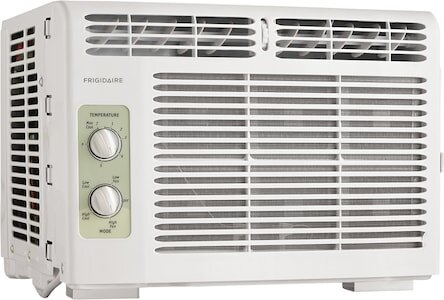

Frigidaire price/availability via Town Appliance; Midea 4.4★ on Amazon when checked Sept. 2026 — both may not match the current listing.
If you choose mini-split

If you choose central
Replacing an existing system because of a specific failure? Start with AC compressor replacement cost — it's the repair that usually forces the decision.
Shopping central AC?
Browse equipment pricing to understand the hardware cost before speaking with an installer. Have the actual system sized and matched professionally.
Browse central AC equipment →As an Amazon Associate, Senville affiliate and Town Appliance affiliate we earn from qualifying purchases. Prices shown are as checked and may not match the current listing — the real, current numbers are whatever the retailer's own product page shows when you click through.
Sizing your AC correctly
"Properly sizing an air conditioning system is critical. An oversized unit will cycle on and off too frequently, increasing wear and reducing dehumidification. An undersized unit will run constantly without adequately cooling the space."
— Air-Conditioning, Heating, and Refrigeration Institute (AHRI)
Window Unit Sizing (DOE/ENERGY STAR guidance)
A BTU is how much heat the unit can move out of the room in an hour. Bigger room, bigger number. But as the AHRI quote above says, bigger is not simply better: an oversized unit cools the air so fast that it shuts off before it has pulled the moisture out, and you end up with a room that is cold and clammy. Size it to the room, not above it.
Room Size
- 100-150 sq ft → 5,000 BTU
- 150-250 sq ft → 6,000 BTU
- 250-350 sq ft → 8,000 BTU
- 350-450 sq ft → 10,000 BTU
- 450-550 sq ft → 12,000 BTU
Adjustments
- Sunny room: Add 10%
- Shaded room: Subtract 10%
- Kitchen: Add 4,000 BTU
- 2+ people regularly: Add 600 BTU/person
Central AC Sizing
Central AC is sized in "tons" (one ton = 12,000 BTU), based on heat gain, insulation, windows, orientation, climate, ductwork and other factors — not square footage alone. Have a licensed contractor perform a proper heat-load calculation (commonly a Manual J or equivalent assessment) before buying equipment.
Is central air cheaper than window units monthly?
It depends on how many rooms you're cooling. Per room, window units are cheaper — about $31 a month each, against about $86 a month for central air, which cools the whole house for that price. In one worked example (1,500 sq ft home, 8 hours a day, 4-month season, U.S.-average electricity), three window units cost about the same per month as central air — but that crossover isn't universal, and shifts with room size, efficiency, electricity rates and hours of use.
How many window units does it take before central AC costs less to run?
By cooling capacity alone, a 3-ton central system (36,000 BTU) is roughly equivalent to 3-4 large window units. But the running-cost question is different: our worked example shows the crossover arriving around three rooms, because multiple window units typically cost more to operate than one efficient central system at that scale.
Can you install central AC without existing ductwork?
You can add ductwork, but it's a substantial part of the total installation cost and disruption. A ductless mini-split is often a better fit for a home without existing ducts — permanent, zoned cooling without that construction.
Is a mini-split cheaper than central air?
Usually, for the same coverage, since it skips ductwork entirely — installed mini-split zones typically run $1,500-$4,500 each against $3,000-$7,500+ for central air. For whole-home coverage across several rooms, the number of zones you'd need can add up to a similar or higher total than central air, so the answer depends on how many rooms you're actually cooling.
Which lasts longer: central AC or a window unit?
Central AC systems last 15-20 years with annual maintenance. Window units typically last 8-12 years. Central systems have replaceable components (compressor, fan motor) that can extend lifespan. Window units are generally replaced as whole units when they fail.
Sources
- U.S. Department of Energy — "Central Air Conditioning"
- U.S. Department of Energy / ENERGY STAR — room air conditioner sizing guidance
- ENERGY STAR — "Heating and Cooling"
- Air-Conditioning, Heating, and Refrigeration Institute (AHRI)
- Zillow — historical home-value analysis, central air conditioning
- Today's Homeowner — "Air Conditioner Noise Measurement"
Did you find this helpful?
Know someone deciding how to cool their home?
Compare something else
More Air Conditioning Guides
Understand your current system
Maintain it