How Old Is My Washing Machine? Whirlpool, Maytag, GE and Other Brands
Find how old your washer is from its serial number: Whirlpool, Maytag, GE, LG, Samsung, Kenmore and more. Pick your brand, enter the serial, and we'll decode the manufacture date.
Where’s the serial number?↓
- Top-loaders: under the lid, on the rim of the opening — lift the lid and look at the metal lip.
- Top-loaders: on the back panel near the top edge, above the control console.
- Front-loaders: around the door opening, on the rim visible when the door is open.
- Front-loaders: behind the door on the frame, or occasionally low on the front panel behind the pump access hatch.
Not the model number printed alongside it. On many washers the model number is the more prominent of the two, but it carries no date.
- Whirlpool also builds Maytag, KitchenAid and Amana washers — they share one serial scheme, and its letter code repeats on a long cycle, so check the decoded year against your purchase date.
- LG and Frigidaire year codes repeat every 10 years, so a decoded year may have an older twin.
Is your washing machine broken, or are you just checking?
The age means different things depending on the answer. Pick one and we'll show you only what applies.
What the age actually means for a washing machine
A washing machine typically lasts 8–14 years, averaging about 10.
What does the age mean if something is wrong?
Age changes the economics; symptoms tell you what to diagnose. Neither alone determines the answer.
Usually worth diagnosing/repairing
Replacement becomes more worth considering when
Still not sure? See the full repair-or-replace guide →
And the money: An expensive repair on a washer near or beyond its typical lifespan deserves closer comparison with replacement.
Where a washing machine sits in its lifespan
8–14 years
Typical range
~10 years
Planning average
Early life (Years 1-4)
Isolated faults can occur (drain pump, lid or door switch), but a major repair is less likely to make replacement economical yet.
Mid-life (Years 5-8)
Wear-related repairs become more relevant, and repair history starts to matter more than the age number alone. Suspension, bearing, seal and control issues are examples, not the only possibilities.
Planning window (Years 9-12)
Expensive or labour-heavy repairs deserve more scrutiny as the washer approaches its typical lifespan. Major bearing, tub, transmission or control-board work are examples of repairs where replacement economics may become more relevant.
Beyond typical range (Years 13+)
A working machine can keep going, but an expensive repair deserves closer scrutiny. Some older machines may use more water and energy than current efficient models.
*Actual lifespan depends on usage, maintenance and quality. Well-maintained appliances often exceed these averages.
If there’s a problem, age changes the repair economics; if it’s working, maintenance is the next step.
Some of the most expensive washer repairs are driven as much by labor as by the failed part itself — bearing and tub work can require extensive disassembly, so a repair can look out of proportion to what actually broke, and that gap tends to widen as a machine ages.
On a younger washer, isolated pump, switch, hose or control issues are often easier to justify repairing because much of the machine's expected life may remain. As washers age, labor-heavy bearing, tub, transmission and control repairs become more relevant to the repair-vs-replace decision, and repair history starts to matter as much as the age number itself.
A useful screening line: a repair approaching half the price of a comparable new machine is worth treating as a warning sign, especially on an older washer — but age, repair history and the specific failure still matter more than any single number.
Things worth knowing about your washing machine
Front-loaders changed the water maths
Front-loading machines tumble clothes through a shallow pool instead of filling a full drum, cutting water use substantially per load. The trade-off is complexity: more electronics and a door seal that needs wiping, in exchange for lower running costs.
Banging or walking doesn’t automatically mean it’s broken
An unbalanced load or unlevel feet are simple things to rule out first, before assuming a real fault. Redistribute the load and check the feet before calling anyone.
Bearing noise can be an expensive turning point
A persistent growl or rumble during spin can indicate bearing wear. Because bearing access can require major tub disassembly on some machines, labour can make the repair expensive — especially on an older washer.
Common questions
How can you tell how old a washing machine is?
Locate the serial number — under the lid rim on a top-loader, or around the door opening on a front-loader — and enter it above. The manufacture date is encoded in the serial by nearly every manufacturer.
Where is the serial number on a washing machine?
On top-loading machines, lift the lid and check the rim of the opening, then the back panel near the top. On front-loaders, open the door and look around the opening rim or on the frame behind it.
How long does a washing machine last?
Most washing machines last 8 to 14 years, averaging about 10. Design complexity, usage and maintenance can all affect lifespan; simpler machines may have fewer components that can fail, but washer type alone doesn’t determine longevity.
Is it worth repairing a 10-year-old washing machine?
It depends on the part. Pumps, switches and hoses are often relatively straightforward, lower-cost repairs usually worth diagnosing before considering replacement. Bearings, the transmission or the main control board on a 10-year-old machine usually cost enough that replacement is the better value.
For washers that are still working, maintenance and leak prevention are the practical next steps.
Recommended products
Help an aging washer last
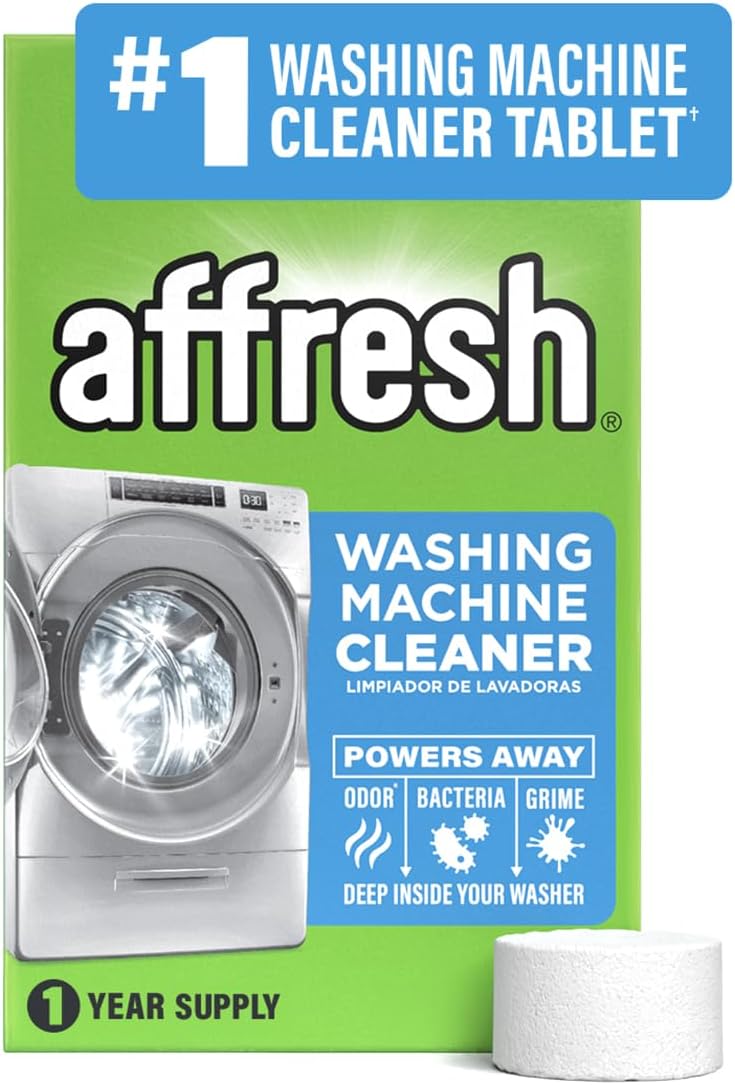
Affresh Washing Machine Cleaner
Useful for residue and odor maintenance, especially on front-loaders.
Check price on Amazon →
Braided Stainless Steel Supply Hoses (2-Pack)
Worth checking or replacing if your existing rubber hoses are old or showing wear — a failed supply hose is a common cause of water damage.
Check price on Amazon →As an Amazon Associate we earn from qualifying purchases. How this works
The tool above reads these automatically — this is the reference if you want to check it yourself, or your brand isn’t listed above. Where the sticker is on a washing machine is covered in step 1 — below is how each brand encodes the date once you’ve found it.
How old is my Whirlpool, Maytag or KitchenAid washing machine?
- Covers:
- Whirlpool, Maytag, KitchenAid, Amana, Jenn-Air, Roper, Inglis, Kenmore (Whirlpool-built) — they share one dating scheme.
- What the serial looks like:
- A letter, then a year code (letter or digit), then digits — e.g. C21234567. The 3rd-4th digits are the week (01-53).
- Reading the year:
- Whirlpool reuses letter year codes about every 30 years (e.g. A = 2021 or 1991) — the week digits and your purchase era settle it.
- Don’t use:
- Not the model number (starts with letters like WRF, MVW, KDT). The serial is the second code on the same tag.
- Worked example:
C21234567 → March 2012
How old is my GE washing machine?
- Covers:
- GE, General Electric, GE Profile, Café, Monogram, Hotpoint (US only) — they share one dating scheme.
- What the serial looks like:
- Two letters + 6 digits, sometimes a letter at the end (e.g. TL123456B)
- Reading the year:
- GE reuses year letters every 12 years, so one serial can match two or three plausible years — pick the one that matches when you bought or moved in.
- How we narrow it down:
- When we can find a dated GE spec sheet or a retailer's listing history for the specific model, we narrow the cycle automatically instead of defaulting to the newest option — for example, GE's own GSD2100V/2101V dishwasher spec sheet is stamped April 2011, which rules out a 2024 or 2000 reading of that model's serial. See our full case log.
- Don’t use:
- Not the model number (the longer code with digits and letters mixed throughout, e.g. GTS18GTHWW).
- Worked example:
TL123456 → October 2018
How old is my LG washing machine?
- Covers:
- LG, Kenmore (LG-built) — they share one dating scheme.
- What the serial looks like:
- Starts with 3 digits: first = year, next two = month 01-12 (e.g. 810KW... = Oct 2018)
- Reading the year:
- The year is a single digit, so it repeats every 10 years (8 = 2018 or 2008) — your purchase era settles it.
- How we narrow it down:
- When a dated LG spec sheet, press review, or discontinued-model listing exists for the specific model, we use it to rule out impossible cyclic years instead of assuming the newest one — for example, LG's own WM2455 washer spec sheet is dated February 2008 and the model is on LG's discontinued list, which rules out a 2019 reading of that model's serial. See our full case log.
- Don’t use:
- Not the model number (starts with letters, e.g. LFXS26973S).
- Worked example:
810KWXX12345 → October 2018
How old is my Kenmore washing machine?
- Covers:
- Kenmore, Kenmore Elite, Kenmore Pro, Sears — they share one dating scheme.
- What the serial looks like:
- Whatever the actual builder uses — Sears sold other makers' machines under the Kenmore name. Enter the serial and, if you have it, the model number.
- Reading the year:
- Kenmore units were built by Whirlpool, LG, Frigidaire and others, each with its own dating scheme. Where a serial reads plausibly on more than one of them, the model number settles it.
- How we narrow it down:
- We identify the actual builder from the model number's 3-digit prefix and defer to that builder's own scheme in full — including every plausible cyclic year, not just its top pick — rather than collapsing to a single guess. For a specific model line where we've found dated corroboration, we narrow further: one LG-built Kenmore refrigerator line (prefix 795.72043) is bounded to before 2015 based on owner reports and a contemporaneous review of the sibling product line. See our full case log.
- Don’t use:
- The MODEL number is genuinely useful here (it starts with three digits and a dot, e.g. 110.45862400) — it tells us who built the unit. Enter it in the model box if the serial alone is ambiguous.
- Worked example:
810KWXX12345 → October 2018
How old is my Samsung washing machine?
- What the serial looks like:
- 15 characters — the 8th is the year letter, the 9th the month (on short 11-character serials it's the 4th and 5th)
- Reading the year:
- Samsung reuses year letters every 20 years, so the letters that have come round again (L, R, T, W, X, Y) match two plausible years — your purchase era settles it.
- Don’t use:
- Not the model number (starts with RF, WF, DW etc.). The serial is on the same sticker, usually below a barcode.
- Worked example:
0AB74AEKA00123Z → October 2018
How old is my Frigidaire or Electrolux washing machine?
- Covers:
- Frigidaire, Electrolux, Kenmore (Electrolux-built), Gibson, Kelvinator, Tappan, White-Westinghouse — they share one dating scheme.
- What the serial looks like:
- Usually two letters + digits; some 10-character serials use digit + product letter (e.g. 4A53011705). Date starts at character 3: year digit + week.
- Reading the year:
- Only the last digit of the year is encoded, so it repeats every decade (8 = 2018, 2008 or 1998) — go by when you bought the home or unit.
- How we narrow it down:
- For models with a traceable retail history, we check when the exact model was actually being sold rather than assuming the newest decade — for example, the Frigidaire FFBD2406N dishwasher shows up in retailer archives from early 2013 with no listing after 2015, which rules out a 2022 reading of that model's serial. See our full case log.
- Don’t use:
- Not the model number (mixes letters throughout, e.g. FFTR1814TW).
- Worked example:
NF81064326 → March 2018
How old is my AEG washing machine?
- What the serial looks like:
- An 8-digit serial such as 13500016: 1st digit = year's last digit; digits 2-3 = production week (01-52).
- Reading the year:
- Only the last digit of the year is encoded, so the serial alone cannot distinguish decades (for example, 1 could mean 2001, 2011, or 2021). Check the machine's age and keep the alternatives in view.
- Don’t use:
- Not the PNC (Product Number), a separate number on the same plate that is often 9 digits and may start with 9. Enter the number labelled Serial number.
How old is my Electrolux (Europe) washing machine?
- Covers:
- Electrolux (Europe), Zanussi — they share one dating scheme.
- What the serial looks like:
- A short all-digit number with no letters (e.g. 61300719): 1st digit = year's last digit, 2nd-3rd digits = week 01-52. Different from North American Electrolux, which is the separate "Electrolux (North America)" option built by Frigidaire.
- Reading the year:
- Only the last digit of the year is encoded, so it repeats every decade (a 1 could be 2021, 2011 or 2001) — go by when you bought the home or unit.
- Don’t use:
- Not the Product Number (PNC) — a separate number on the same plate, often 9 digits starting with "9", that is not a date. Look for the field actually labelled "Serial number", not "Prod. No." or "PNC".
- Worked example:
13500016 → September 2021
How old is my Bosch washing machine?
- Covers:
- Bosch, Thermador, Gaggenau, Siemens, Neff — they share one dating scheme.
- What the serial looks like:
- The FD number: "FD" + 4 digits (FD 0301 = Jan 2023), often with extra digits after it (FD030100233 works too)
- Don’t use:
- NOT the E-Nr — that's the model number, and it's the first thing you'll see on the tag. The date lives only in the FD number next to it.
- Worked example:
FD030100233 → January 2023
How old is my Speed Queen washing machine?
- Covers:
- Speed Queen, Alliance Laundry, Huebsch, UniMac — they share one dating scheme.
- What the serial looks like:
- All digits, usually 10, starting with the two-digit year — e.g. 1505000001 = May 2015
- Reading the year:
- The year and month are both stated in full digits, so there is no decade or cycle to guess between.
- Don’t use:
- Not the model number (letters and digits mixed, e.g. TR7003WN). The serial is the all-numeric code.
- Worked example:
1505000001 → May 2015
How old is my Fisher & Paykel washing machine?
- Covers:
- Fisher & Paykel, DCS — they share one dating scheme.
- What the serial looks like:
- Two or three letters then digits — e.g. RPU766991. The first letter is the year, the second is the month.
- Reading the year:
- The year is one letter for the final digit of the year, so it repeats every 10 years (B = 2004 or 2014) — your purchase era settles it.
- Don’t use:
- Not the model or product code (E522B, RF522BLPX6, DD24DDFTX2) — that names the model line, not the build date.
- Worked example:
RPU766991 → July 2016
How old is my Midea washing machine?
- What the serial looks like:
- Washers: 22 characters, e.g. 240100007015A010120001 (positions 12-13 are the year and month). Refrigerators: dash-separated, e.g. 340-B8250401-1113-10C0223 (the 3rd segment's first two digits are the year and month).
- Reading the year:
- Midea encodes only the last digit of the year, so it repeats every 10 years — pick the year that matches when you bought the appliance.
- Don’t use:
- Not the model number printed elsewhere on the same label.
- Worked example:
240100007015A010120001 → October 2025
How old is my Crosley washing machine?
- What the serial looks like:
- Whatever the actual builder uses — Crosley units are made by Whirlpool (laundry, fridges) or Frigidaire (dishwashers). Enter the serial and, if you have it, the model number.
- Reading the year:
- Crosley is built by Whirlpool or Frigidaire depending on the appliance, each with its own dating scheme. Where a serial reads on both, the year is only reported if they agree.
- Don’t use:
- Not the model number (e.g. CAE2743BQ0, VRT21F5AW) — though it is worth entering too, since it identifies the builder.
- Worked example:
C21234567 → March 2012
Did you find this helpful?
Know someone else squinting at a serial number?
The Washing Machine Series
- 1How Old Is My Washing Machine? Whirlpool, Maytag, GE and Other BrandsYou’re here — the tool above.
- 2How Long Does a Washing Machine Last?How lifespan changes with age, what can shorten it, and what to watch as the machine gets older.
- 3Should You Repair or Replace a Washing Machine?The decision, in one place — including the "is it actually broken" check.
- 4How Much Does It Cost to Replace a Washing Machine?Unit price by tier, installation cost, and repair costs by part.